FDCPA violation
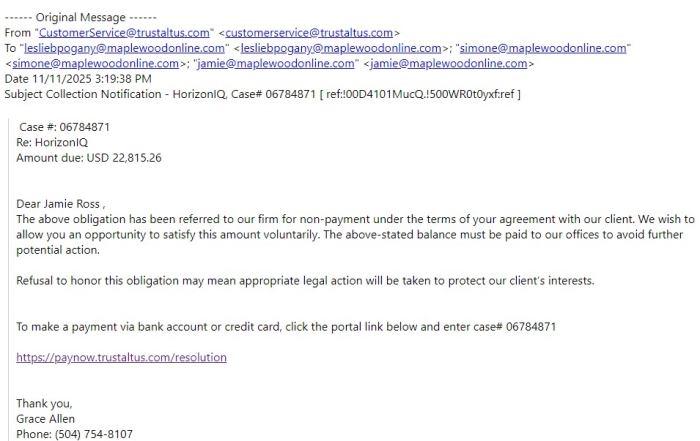

I asked if NJ had protections for small businesses
Given that your debt was incurred in a business context (your sole proprietor LLC) and the communication went to your wife (who apparently is not part of the business), the existence of the CFA suggests you may have a legal basis under New Jersey law for a claim of deceptive or unfair business practice (rather than a straightforward FDCPA claim).
The CFA’s broad language means you could argue: the collection agency’s disclosure of business-debt information to an unauthorized third-party spouse was a “deceptive or unconscionable act” in trade or commerce, causing you (or your business) a loss (e.g., reputational, or business disruption).
That said, the CFA was designed more for consumer protection, so your situation may require careful legal analysis (especially to prove “ascertainable loss”, and that the business-debt context is covered).

I thought I could get them for the FDCPA violation - but that pertains to personal debt - here's the info for businesses:
Because this was a business debt (a commercial account under your sole proprietorship) rather than a personal or household debt, the FDCPA likely does not apply in the same way it does to consumer debts.
However, that doesn’t mean the collector is off the hook — there are still privacy, professional, and sometimes contractual boundaries they can violate. Let’s unpack what this means for you:
⚖️ 1. Why the FDCPA Probably Doesn’t Apply
The Fair Debt Collection Practices Act (FDCPA) covers consumer debts — defined as debts incurred “primarily for personal, family, or household purposes.”
So debts tied to a business, LLC, or sole proprietorship for business operations are generally excluded.
That’s why firms like Altus / TrustAltus often market themselves as “commercial collectors” — they work in a space not regulated by the FDCPA.
However, some courts have found limited exceptions when the “business” is effectively indistinguishable from the person (like a sole prop using personal credit), but those are rare and depend on how the debt was structured.
🧩 2. Still Problematic: Privacy Breach & Reputation Harm
Even though FDCPA doesn’t apply, emailing your wife about your business debt is still improper — potentially even defamatory or privacy-invasive, especially if:
She’s not part of the business,
They included specific financial details, or
The email implied you were personally delinquent or untrustworthy.
That could expose them to claims under:
State privacy laws (intrusion or public disclosure of private facts),
Tortious interference (if the disclosure harmed your personal or business reputation), or
Professional ethics complaints, if they’re licensed collectors bound by state collection statutes (many states require commercial collectors to maintain confidentiality).
🧾 3. What You Can Do
You have a few options, depending on how far you want to go:
Option A – Formal Complaint
File a complaint with your state’s Department of Financial Institutions or Attorney General’s office.
Even though FDCPA doesn’t apply, many states have parallel laws for “unfair or deceptive collection practices” that extend to business contexts.
You can also file at the BBB and CFPB, noting that it’s a commercial debt but that private data was wrongly disclosed.
Option B – Direct Legal Notice
Send a short letter or email to the collection agency’s compliance department, stating:
This usually gets immediate attention from their legal department.
Option C – Consult a Business Attorney
A consumer rights or business-law attorney can help you send a cease-and-desist and possibly pursue a privacy tort claim if the disclosure caused measurable harm (emotional, reputational, or financial).
🧭 4. Next Steps I’d Recommend
Save the email your wife received (headers and full body).
Note exactly what was disclosed.
Confirm whether she’s listed anywhere as a contact or authorized representative (if not, that strengthens your position).
Send a brief, professional notice to their compliance/legal team (I can help you draft it).
Optionally file a BBB or state AG complaint to document the breach.
Here's the letter - the copied Leslie from Bunny's as well. Don't why - maybe I'm associated with their domain name at one point. But that email doesn't go anywhere.